Master the Claude 5 Family
Fable 5, Opus 5, and Sonnet 5: How to build, code, automate, and ship real work with Claude 5 Models

Claude 5 is powerful enough to save you a week of work.
It is also powerful enough to spend hours carrying the wrong instructions, using unnecessary tools, and finishing a job you did not actually ask for.
That is the first thing I learned from working with this new family.
Fable 5 can remain inside a difficult project for hours. Opus 5 can inspect a codebase, make architectural decisions, build across many files, run tools, review its own work, and correct mistakes. Sonnet 5 is fast and affordable enough to handle everyday coding, research, writing, automation, and worker-agent tasks at scale.
But the models are only one part of the system.
A giant CLAUDE.md full of old rules can make them worse. Maximum effort on a tiny edit can burn tokens without improving anything. Ten MCP servers can fill the context before Claude starts the real job. Telling Opus to verify the same answer again and again can waste the intelligence you are paying for.
Anthropic removed more than 80% of Claude Code’s system prompt for the new generation without a measurable loss on its coding evaluations. That is not a small prompting tip. It is a warning that the old way of controlling Claude has started to expire.
Claude 5 does not need a longer prompt around every move.
It needs a clear job, a clean working environment, the right model at the right effort, useful tools, and a finish line it can actually prove.
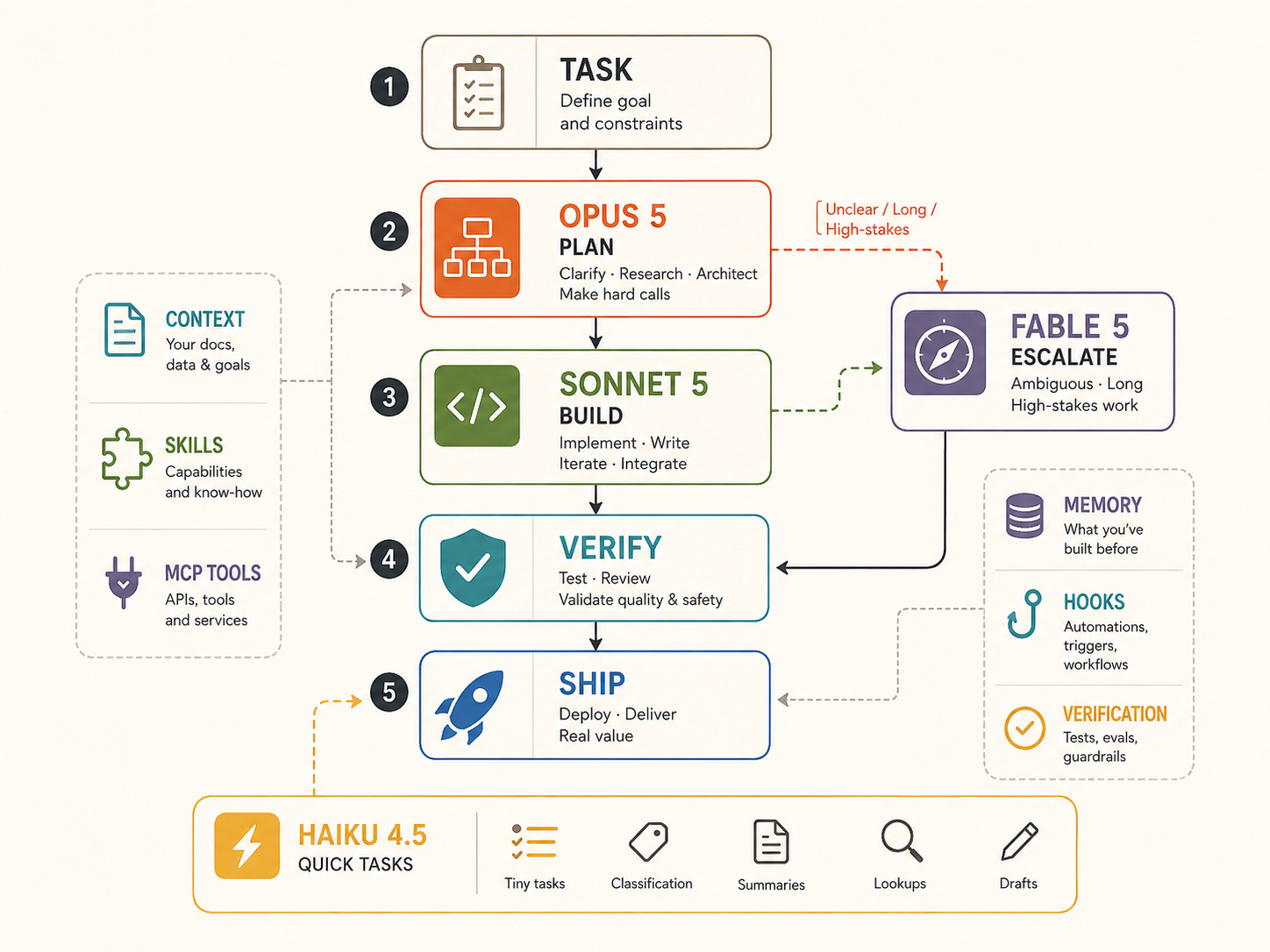
This guide builds that system from the terminal upward. We will set up Claude Code, clean the context, create reusable Skills, connect MCP tools, build verification loops, route work between Fable, Opus, and Sonnet, use subagents without wasting money, and take one feature from a written request to tested code.
The important change is not simply that Claude became smarter.
The important change is that you can now give it a larger piece of real work and expect the system around the model to carry that work properly.
Inside the full guide: the exact terminal setup, model and effort rules, copy-ready prompts, a clean CLAUDE.md, Skills, MCP commands, plugins, hooks, subagents, agent teams, graph workflows, verification, and a complete plan-to-shipping example.
