Claude Code After Generation 5 Models: The Master Guide
A beginner-friendly guide to using Claude Code with better context, stronger models, and practical automation.

Claude Code changed twice in the same month.
First, the models became strong enough to stay inside a difficult problem for much longer. Then the tool around them learned how to keep that work moving without waiting for another prompt after every step.
Opus 5 arrived on July 24 with stronger judgment, deeper root-cause analysis, better self-verification, and performance close to Fable 5 at roughly half its price. Sonnet 5 had already become a far more capable daily model. Fable 5 was built for work larger than one sitting. Claude Code also added completion goals, adjustable effort, verification Skills, one-million-token sessions, and dynamic workflows that can coordinate many agents through an executable plan.
Then Anthropic revealed something more interesting than another benchmark.
For Opus 5 and Fable 5, it removed more than 80% of Claude Code’s system prompt without a measurable loss on its coding evaluations. Many instructions that used to keep older models on track had become friction. The stronger models no longer needed every decision explained, every rule repeated, or every possible failure predicted in advance.
That changes the way Claude Code should be used.
The old instinct was to write one enormous prompt and control every move.
The better approach now is to build a small working environment around Claude: give it the right project context, a clear target, useful tools, somewhere to record decisions, and a judge that can prove whether the work is finished.
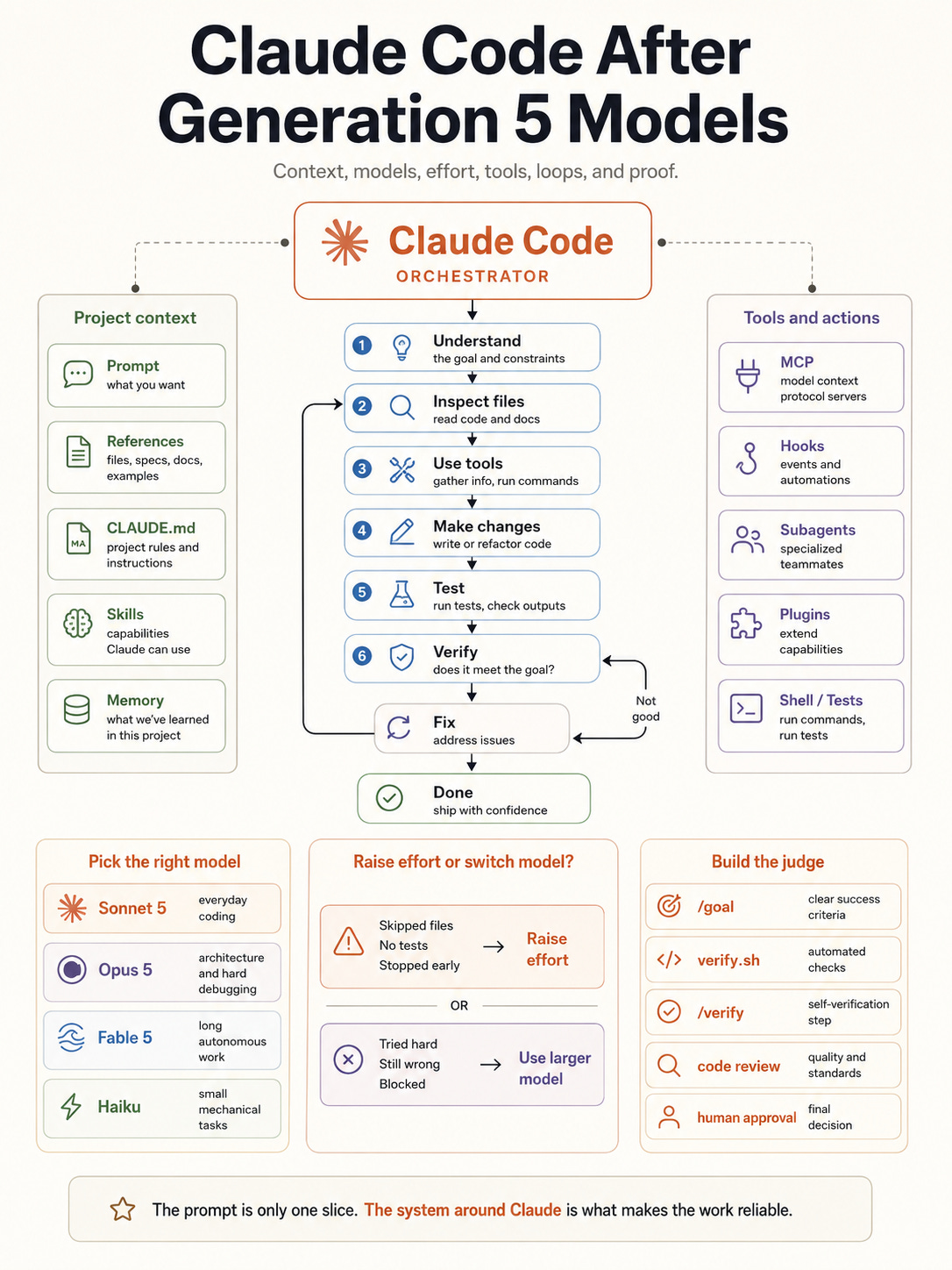
The prompt gets smaller.
The system around it gets better.
That is the real subject of this guide.
Inside the full guide, you’ll get the complete Claude Code setup for the newest Claude models, how to choose between Sonnet 5, Opus 5, and Fable 5, use effort levels wisely, build project memory with CLAUDE.md, create Skills, connect MCPs and plugins safely, run subagents, loops, and graph workflows, and follow a practical start-to-finish system with commands, prompts, verification, and real examples you can use immediately.
