Eval Engineering: A Beginner’s Guide
How to turn prompts, tools, loops, and agent graphs into a system that can prove its work.

The agent reached the end.
The job still failed.
An AI agent can complete every visible step and still fail the real task.
It can search, call tools, write files, hand work to another agent, and produce a clean final answer. Nothing crashes. The graph reaches END. The user sees confidence.
But the search returned nothing. The first agent invented the missing detail. The next node accepted it as context. The final node polished it. The whole system failed quietly.
One reported production analysis in the material behind this guide found exactly this kind of gap: response quality scored 83.9%, while faithfulness to the tool results scored only 32.3%. The agent looked useful, but much of its answer was not supported by what its tools had actually returned.
This is why eval engineering is becoming a serious AI skill. It is not another prompt trick. It is the layer that asks a harder question:
Did the agent actually complete the job, with the right evidence, through an acceptable path?
A prompt tells the model what to do. Context gives it information. A loop lets it try again. A graph decides where work moves next. An eval decides whether that work deserves to move at all.
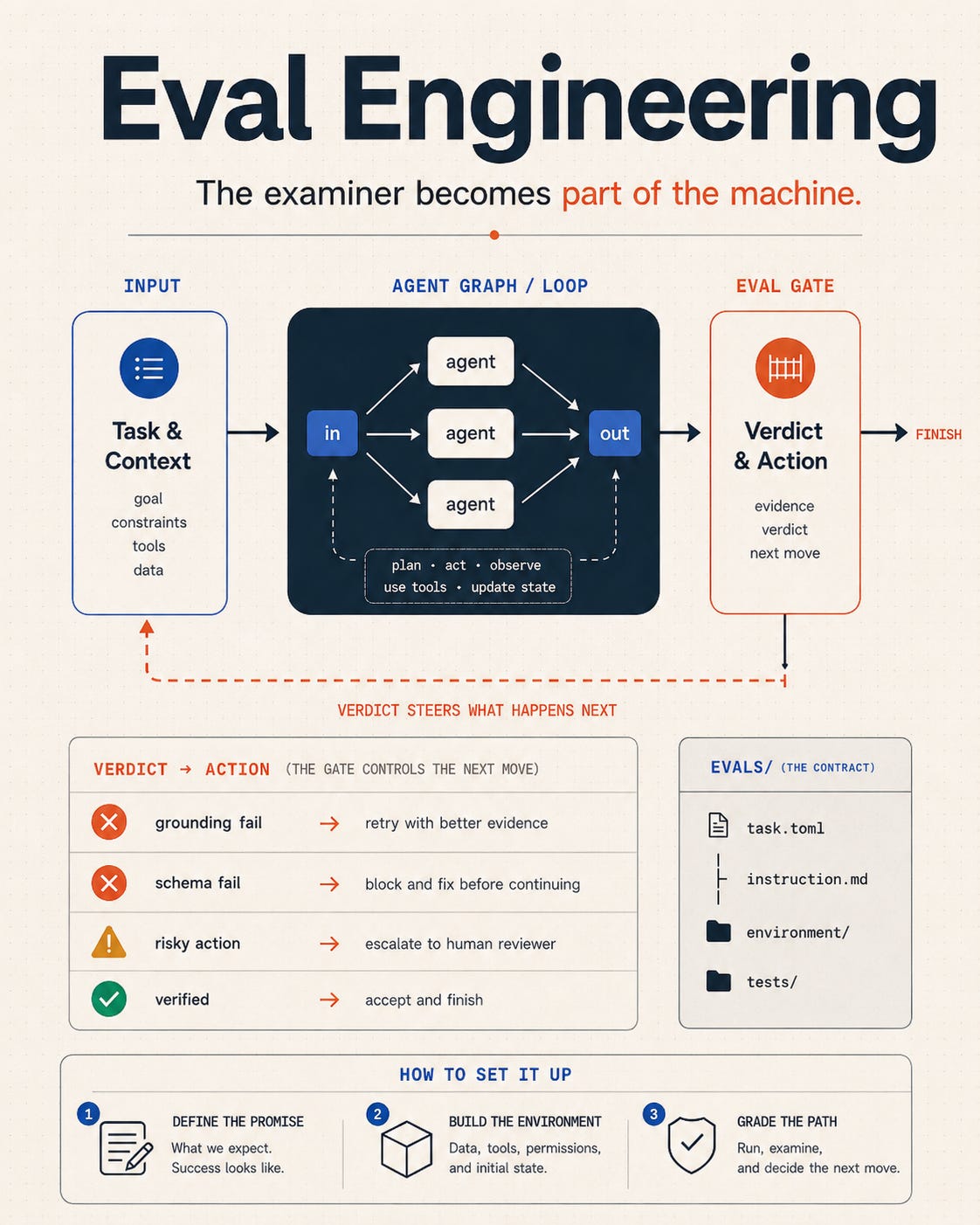
That last decision changes everything.
Inside the full guide, you will build eval engineering from the ground up: define one clear promise, create the three core files, install the LangChain skill and Harbor, generate cold-start test cases, turn real agent traces into permanent evals, combine code checks with LLM and human judgment, wire verdicts back into loops and graphs, choose worker and judge models properly, and launch the five tests every tool-using agent should have before it is trusted.
