
I would pay attention to this job right now
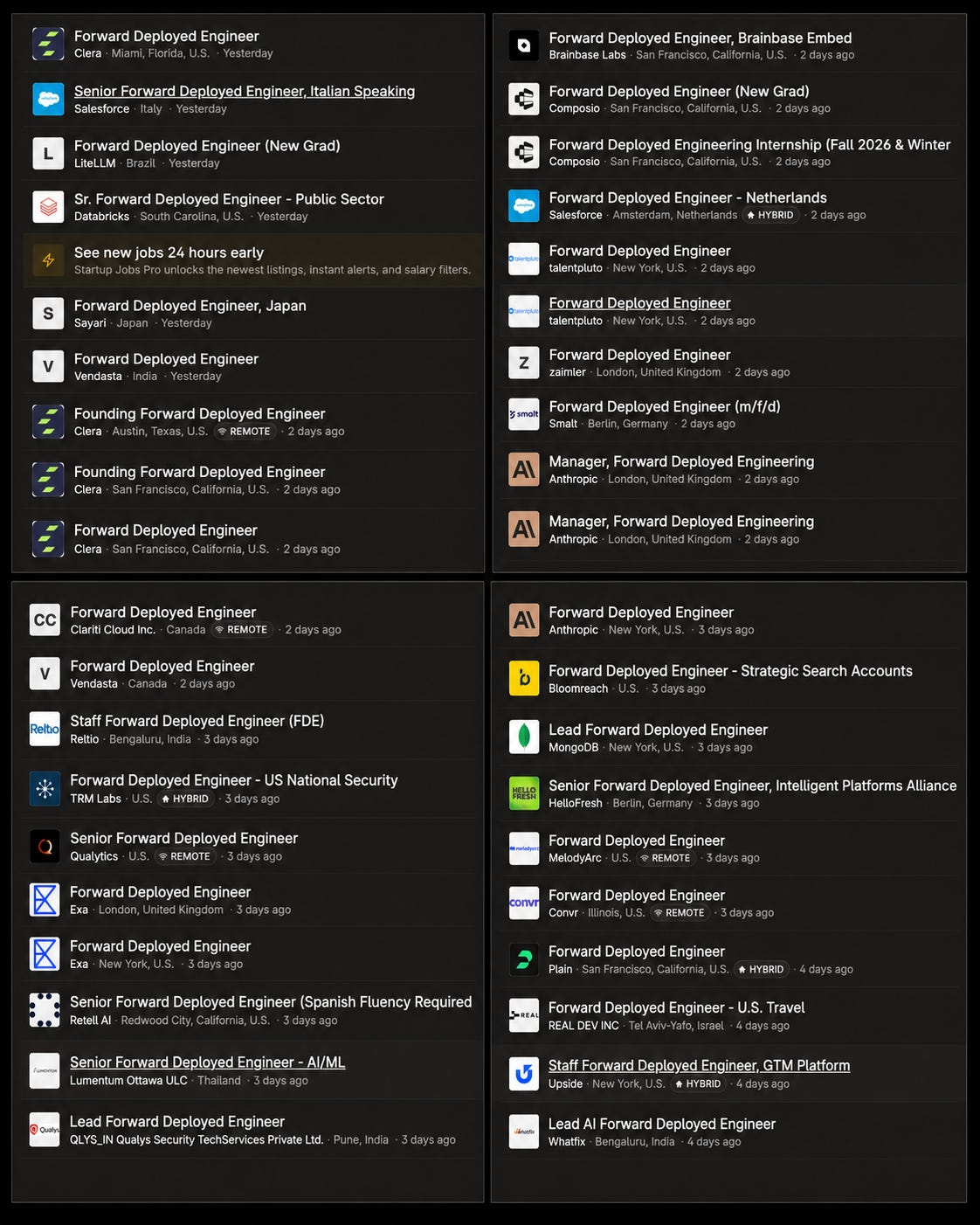
Look closely at that screenshot.
That is only one job platform. And many of those Forward Deployed Engineer jobs appeared within just a few days.
Clera. Salesforce. Databricks. Anthropic. Composio. MongoDB. Startups. New-grad roles. Internships. Senior roles. Jobs in the US, Canada, Europe, Japan and India.
This is becoming a real AI career category.
OpenAI currently has more than 20 Forward Deployed Engineering openings across different locations and industries. AWS has gone even further: it announced a $1 billion investment to build a Forward Deployed Engineering organization and embed thousands of engineers with customers.
And the pay explains why people are suddenly looking at it.
Palantir currently lists new-grad FDE roles around $135K–$145K base, before stock and other compensation. OpenAI lists FDE roles around $162K–$280K base plus equity. Reuters reported that some top FDE packages have already crossed $500K total compensation. At the very top of this career, senior equity-heavy packages can move toward seven figures.
So the interesting part is not simply:
“AI has another new job.”
It is this:
AI companies are beginning to pay extremely well for people who can take a powerful model and make it actually work inside a real business.
That skill is becoming scarce.
And unlike AI research, you do not need to spend years learning how to train a frontier model.
You need to learn how to deploy one.
Browse the current FDE listings here.
The job is much simpler than the name
“Forward Deployed Engineer” sounds like someone working next to a missile launcher.
The actual idea is easier.
A company buys Claude, GPT, Gemini or another AI system.
The demo works.
Then they try to use it inside the company.
Now things get messy.
Their useful data is spread across Salesforce, PDFs, databases and internal software. The model needs permission to use that data. It needs tools. It needs to follow company rules. Someone needs to test its answers. Someone needs to connect it to the existing workflow. And somebody still needs to make sure the thing works next month.
That person is increasingly the FDE.
OpenAI describes the job as owning the path from early discovery through building, deployment and stable production.
A study of 113 AI FDE job descriptions found the same pattern: 90% involved direct customer work, 87% involved building and deploying production systems, and 62% involved API, data or system integration.
So I would describe an FDE like this:
An AI engineer who works very close to the customer and owns the problem until the AI system actually works.
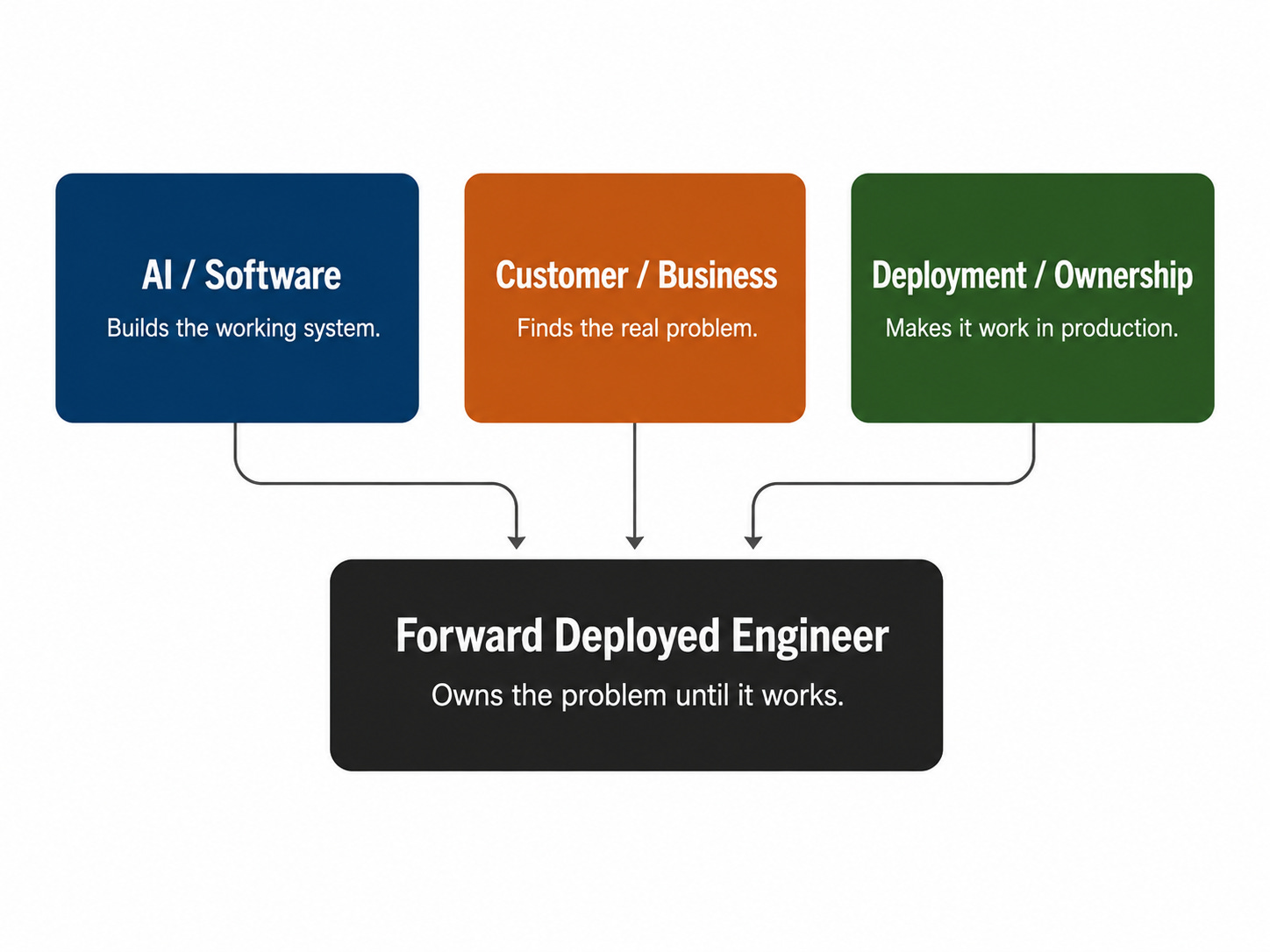
That is the whole job.
And that small difference changes almost everything about how you should prepare for it.
Inside the full guide
If this role interests you, I have made the rest very practical. You do not need another huge AI course. With a focused 8 weeks of learning and building, you can cover most of the core FDE stack and finish with something real to show employers.
Inside, I’ll walk you through:
The complete path to becoming an FDE: what to learn and in what order
The exact skill stack: Python, SQL, APIs, cloud, Docker, RAG, MCP, agents, evals and deployment
Free learning material and resources for almost every skill you need
One real FDE-style project to build from scratch, instead of another useless chatbot
Ready-to-use prompts for customer discovery, codebase research and AI deployment - How to build evals, get real-world experience, create your portfolio and apply for the right jobs
The goal is simple: learn the stack, build one useful system, deploy it for a real user, and come out with actual FDE experience, not just another certificate.
