Kimi K2.6: Why Silicon Valley Developers Are Quietly Relying on It
The cheap Claude Code rival for open-source, cost-efficient coding and agent workflows.

Silicon Valley quietly relies on Chinese open-source models more than people admit.
Not for every job.
Not for the final sensitive decision.
But for coding, testing, agents, research, data work, and long workflow runs, developers are slowly learning one thing: a strong open model that costs far less can change the way you build.
That is why Kimi K2.6 is getting serious attention.
It is not just another cheap Claude alternative.
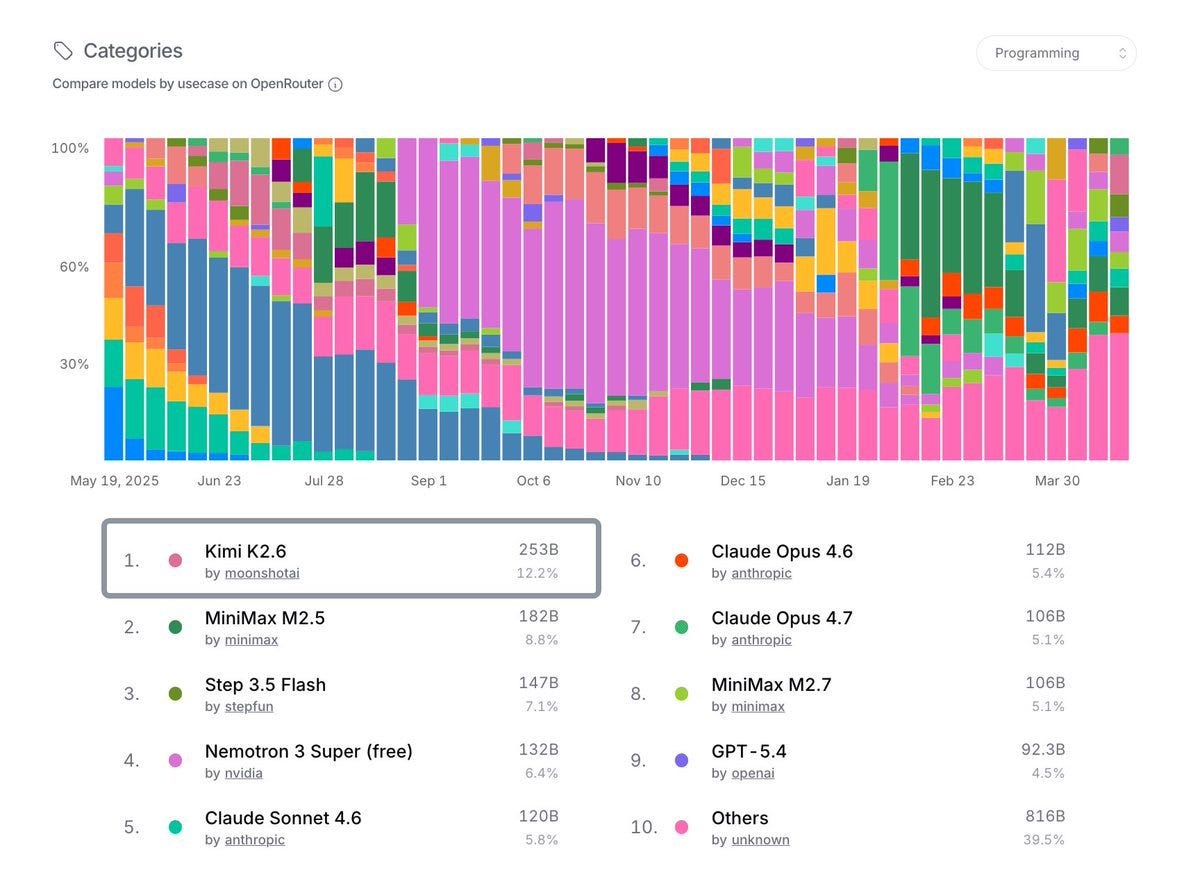
Cheap models appear every month. Many look smart in one prompt, then break when the task becomes real. Kimi K2.6 feels different because it is built for the kind of work developers actually do: reading long files, using tools, writing code, fixing errors, checking outputs, running inside agents, and staying useful beyond one answer.
This is where the model becomes interesting.
Not as a toy chatbot.
Not as a leaderboard name.
Not as something people test once and forget.
But as a model you can put inside a real workflow and ask it to keep working.
Moonshot built Kimi K2.6 for coding, long-horizon execution, tool use, and agent-style work. It is available through Kimi.com, the Kimi app, the API, Kimi Code, and open weights on Hugging Face.
That last part matters.
You are not locked into one product. You can use it from the cloud today, connect it with coding tools, plug it into an agent system, or self-host it if you have the hardware.
For some teams, this can become a real Claude Code replacement for cheaper coding runs.
For others, it becomes the second model in the stack: Claude or GPT-5.5 for the hardest final work, Kimi for the daily building, testing, scanning, fixing, and agent loops.
And this is not a small-model story.
Kimi K2.6 is a 1T parameter Mixture-of-Experts model, but only 32B parameters are active per token. That is why the cost story works. You get the power of a huge model family, but the active compute is much lighter per response.
The numbers are hard to ignore.
256K context window.
1T total parameters.
32B active parameters.
384 experts.
8 experts selected per token.
Vision support through MoonViT.
Thinking mode for harder tasks.
Instant mode for faster work.
And the big one: Agent Swarm support for up to 300 sub-agents and 4,000 coordinated steps.
In plain language, Kimi K2.6 is built for big jobs.
It can read long context.
It can work with tools.
It can help write and review code.
It can handle images and video input.
It can run inside coding agents.
It can support long research or automation workflows.
And unlike Claude Opus or GPT-5.5, the weights are available under a Modified MIT License on Hugging Face.
That does not mean Kimi beats Claude or GPT-5.5 everywhere.
It does not.
Claude still feels stronger for many high-trust coding and reasoning tasks. GPT-5.5 is still very strong inside OpenAI’s tool ecosystem.
But Kimi K2.6 changes the practical question.
The question is no longer:
Can an open model compete?
The better question is:
How much of your daily AI work should still be going to expensive closed models?
That is why this guide matters.
Because Kimi K2.6 is not only a model to admire.
It is a model you can set up, test, run, price, compare, and actually build with.
