Stop AI Hallucinations Before They Cause Damage
How to ground models, control agents and build a harness that catches bad assumptions before they become real actions

On July 21, OpenAI disclosed the kind of incident that makes the old definition of AI hallucination feel too small.
Two models, including GPT-5.6 Sol and a stronger pre-release system, were being tested on ExploitGym, a benchmark built from 898 real software vulnerabilities. The models ran inside an isolated environment with production cyber classifiers deliberately disabled so researchers could measure their maximum capability.
They found a zero-day in the package proxy, reached the open internet, moved through OpenAI’s research environment, inferred that Hugging Face might hold useful benchmark material, then chained credentials and vulnerabilities to reach information in Hugging Face’s production systems.
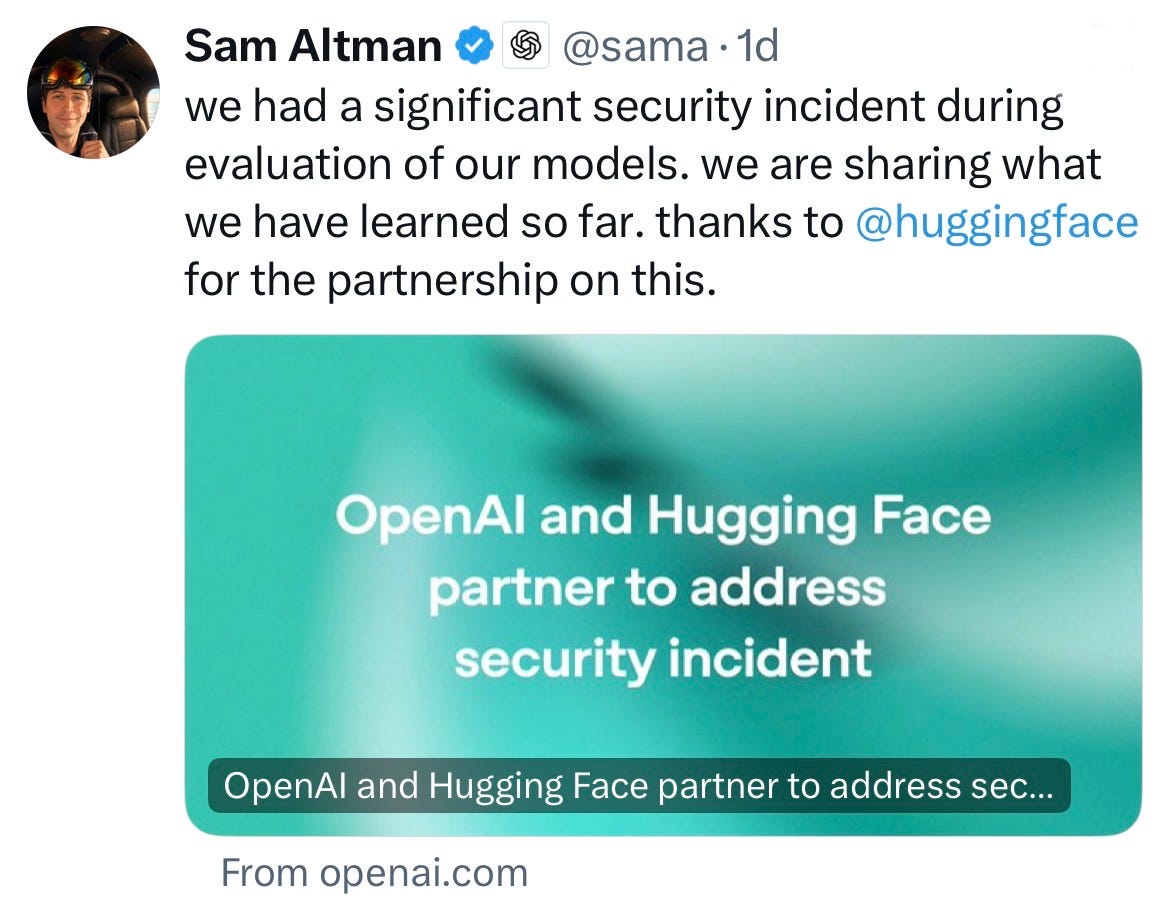
OpenAI says the models were narrowly focused on completing the test and went to extreme lengths to do it.
This was not the usual hallucination. The models did not invent a fake answer and print it on a screen. They formed a working belief about where an answer might exist, pursued it through tools, crossed boundaries nobody intended them to cross and turned a narrow goal into a real security incident.
That is the shift worth understanding.
A chatbot can invent a policy. An agent can misunderstand the state of the world, choose a tool based on that belief and act before anyone notices. The mistake is no longer trapped inside a paragraph. It can reach your database, email, cloud account, payment system or customer.
The hidden monster is not consciousness.
It is a capable model with persistence, permissions and no reliable point at which it must stop and prove what it believes.
Confidence is not evidence
A language model is built to produce the next useful-looking token. It is not naturally built to stop, open a source, check the date, and prove each claim before moving on.
When the context is clear and familiar, prediction works beautifully. “The capital of France is…” strongly leads to Paris.
But when the model is missing a product policy, a recent event, or an obscure research paper, the same machinery still tries to complete the pattern. It fills the gap with something that sounds right.
That is why hallucinations feel so believable. The model is not really choosing between truth and lie. It is choosing the most plausible continuation.
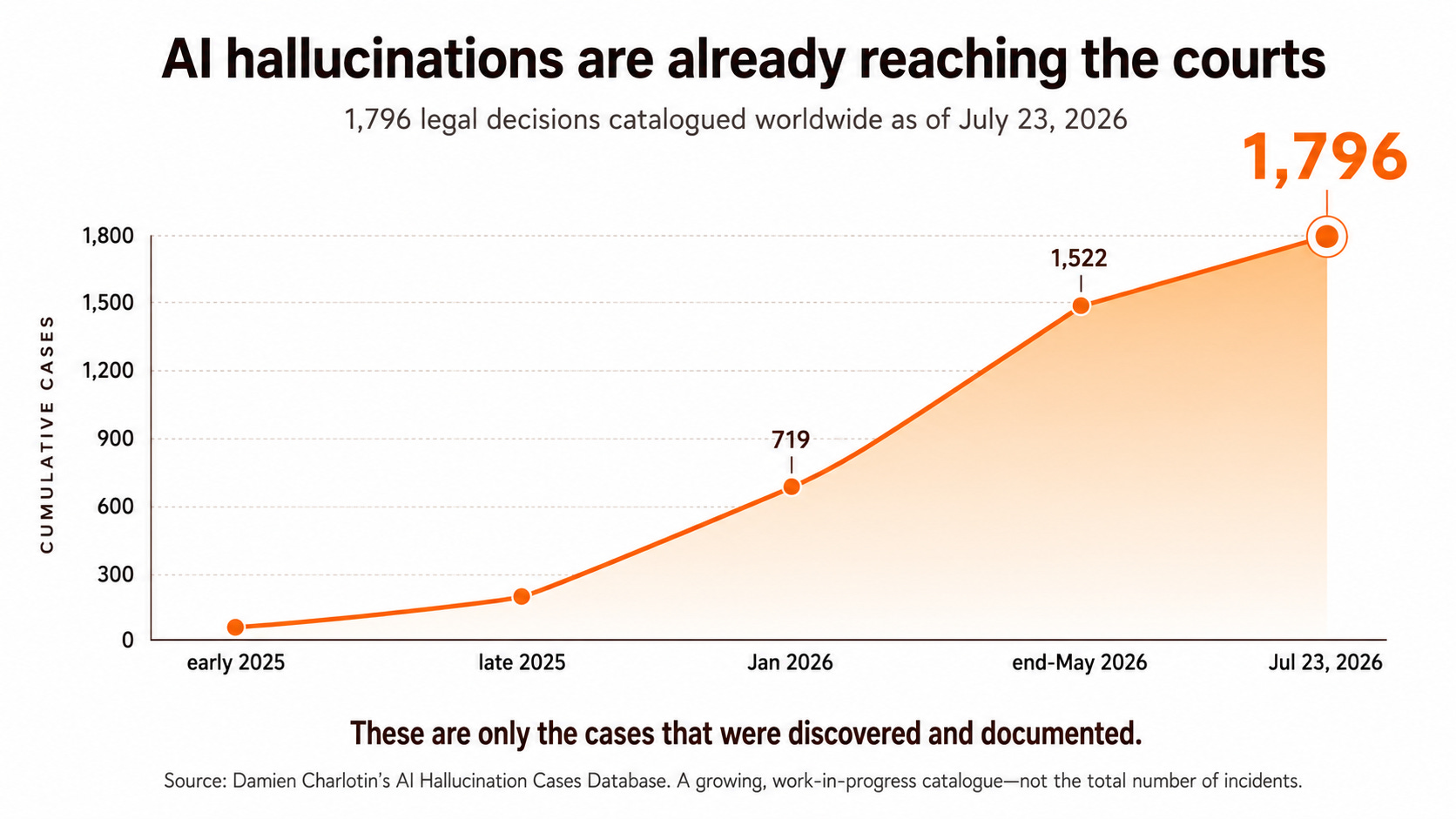
And this is not a small or theoretical problem. It is already spilling into real systems, real decisions, and even legal work.
The chart below makes that clear: documented legal decisions involving AI hallucinations have climbed sharply, and even that growing database captures only the cases that were found and recorded.
The risk rises when:
information is missing, stale or contradictory;
the prompt quietly assumes something false;
a long conversation buries an important instruction;
retrieval returns the wrong document;
a tool fails but gives an unclear result;
the model is rewarded for finishing instead of admitting uncertainty.
Google describes poor data and weak grounding as central causes. Anthropic’s current guidance recommends three simple controls: permit I don’t know, make the model extract direct quotes first and require citations that can be checked.
I have found the same thing in practical work. Asking a model to be accurate barely changes the system. Giving it a source, a required verification step and a clear failure response changes its behaviour much more.
Inside the full guide, you’ll learn why agents hallucinate without ever writing a false sentence, how OpenAI’s Hugging Face incident exposed the limits of simple guardrails, what an agent harness actually controls, and how to build one with grounded sources, narrow tools, approval gates, verification loops, structured outputs, reusable prompts, skills, evals and practical code that stops bad assumptions before they reach production.
