Stop Paying AI Subscriptions: These Local AI Boxes Replace Most Subscriptions for a Few Dollars a Month
A practical guide to choosing a local AI device, setting it up, and moving everyday work away from paid cloud tools.

I need you to notice what is happening before AI becomes another monthly bill you no longer know how to live without.
Not another small software subscription.
A real utility bill.
Something closer to electricity, internet, cloud storage or mobile data: always running, measured by usage and becoming more expensive as you depend on it.
OpenAI CEO Sam Altman recently described the future in unusually clear words:
“We see a future where intelligence is a utility, like electricity or water, and people buy it from us on a meter.”
Read that again.
Intelligence sold on a meter.
The more documents you process, the more code your agents write, the more research they perform and the longer they think, the more you pay.
That is probably where cloud AI is heading.
Today, a serious AI user can already spend more than $400 every month across premium models, coding tools, APIs, image generation and agent workloads. That is nearly $5,000 every year.
Keep the same stack for five years and you are approaching $25,000.
Build a small team around it, let several agents run continuously, and AI stops looking like a software expense. It starts looking like payroll.
This is not a distant prediction. We have already seen an early warning.
When Anthropic released Fable 5, its most powerful public model, it was included in Pro, Max, Team and Enterprise subscriptions—but only temporarily. Anthropic said it planned to remove Fable 5 from those plans after June 22 and require separate usage credits, unless enough capacity became available.
Think about what that means.
You can pay for the premium subscription and still not automatically receive unlimited access to the best model.
The model may be available.
Your subscription may be active.
But the intelligence itself can still move behind another meter.
This is why I would not build my entire work, business or personal knowledge system on rented AI alone. Once your documents, coding workflow, company memory and daily operations depend on one provider, leaving becomes much harder than joining.
You are not only paying for answers.
You are slowly renting your ability to work.
Put the Machine on Your Side of the Meter
Local AI changes this relationship.
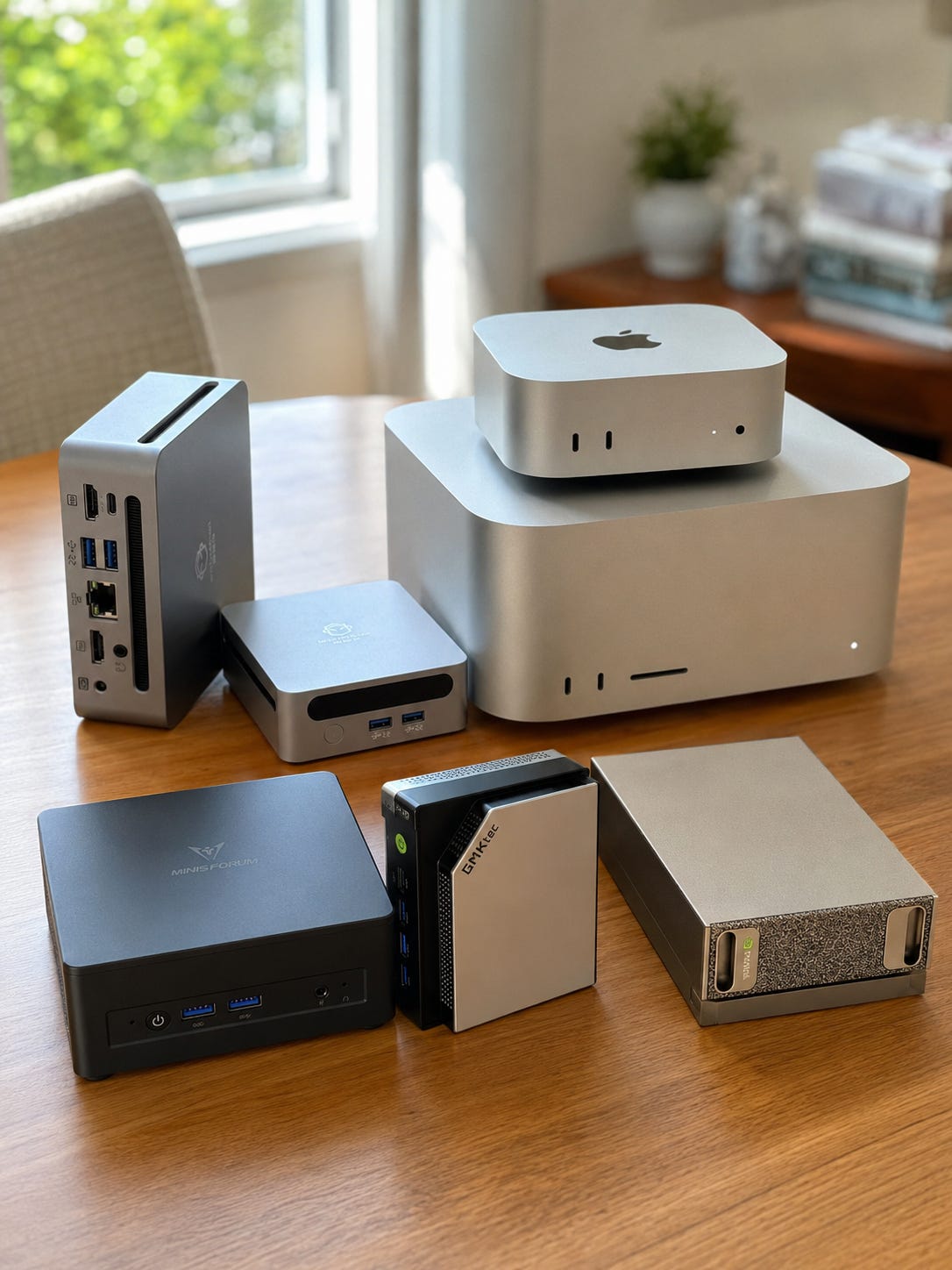
Instead of sending every task to a company’s data centre, you place a small AI machine under your desk. You buy the hardware once, load an open model and use it as often as you need.
No token balance.
No message cap.
No warning that you have reached your weekly limit.
No extra charge because an agent reviewed the same codebase five times overnight.
A quiet, low-power device can run for only a few dollars in electricity each month. Larger local workstations will use more, of course, but their cost remains tied mainly to power—not to every prompt, token, document or agent action.
That difference is enormous.
With cloud AI, processing 100 documents costs more than processing ten.
With local AI, the machine is already running.
With cloud AI, an agent that works all night can leave you with a surprise bill.
With local AI, it mostly leaves you with completed work.
With cloud AI, you may hesitate before repeating a task.
With local AI, the next attempt has almost no additional cost.
The most important promise is therefore not exactly “AI for $3 a month.” Electricity prices and hardware power use vary.
The important promise is:
Zero cost per prompt.
Once the model is on your machine, you can summarize an archive, classify thousands of records, draft hundreds of product descriptions or let several agents work through the night without paying someone for every thought.
That does not mean throwing away Claude, ChatGPT or other frontier models. The smartest approach is not local-only.
It is local first.
Let your own device handle the routine 70–90%: writing, summaries, extraction, private documents, repetitive coding, search across your files and background agents.
Use the cloud only for the smaller number of tasks that truly require the strongest available model.
Own the daily intelligence.
Rent the exceptional intelligence only when you need it.
That one change can turn a future $5,000 annual AI bill into a machine you own, a small electricity cost and perhaps one carefully chosen cloud service.
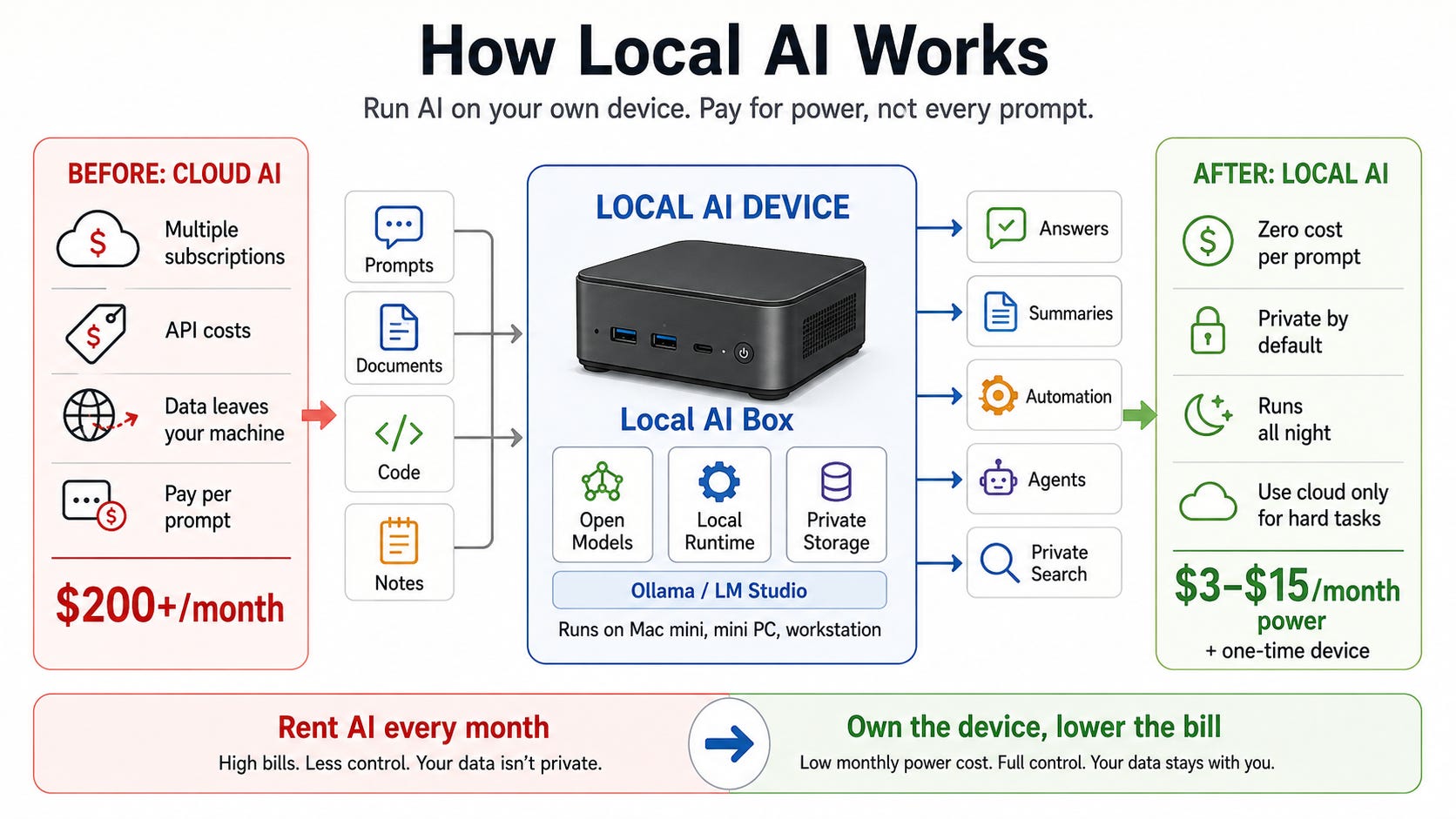
This guide will show you below which machines are worth buying, which models they can honestly run, how to set everything up and how to move your work away from expensive subscriptions without breaking the tools you already use.
