
Vibe coding has become almost dangerously easy.
You can open an AI tool, describe an app in normal English, and have something working before you finish your coffee. Google has now added vibe coding to its own AI Professional Certificate, and says US searches for the term are up 140% from last year. But there is a very important detail: Google is no longer teaching people to simply “prompt an app.” Its course now includes planning, testing, debugging and deployment.
That tells you where this skill is going.
The old version of vibe coding was: tell AI what you want and keep talking until it looks right.
That is still brilliant for a quick prototype.
But if you want to build something people will actually use, the better method now is very different.
You still describe what you want in plain English. You just give the AI a better place to work: a clear plan, a small memory, reusable Skills, the right tools, a few tests and clear rules for when it should stop.
And once you do that, vibe coding becomes much more powerful.
The biggest change is not the model
The new models are obviously much better.
OpenAI now has the GPT-5.6 family for Codex: Sol for harder work, Terra as the everyday model, and Luna for faster and cheaper work.
Anthropic now has Claude Opus 5 and Claude Sonnet 5, with Opus aimed at harder reasoning and longer agentic work.
Google AI Studio can now go from a normal-language request to a full-stack web app, and it can also build native Android apps.
So yes, the models matter.
But I think the bigger change is what we put around the model
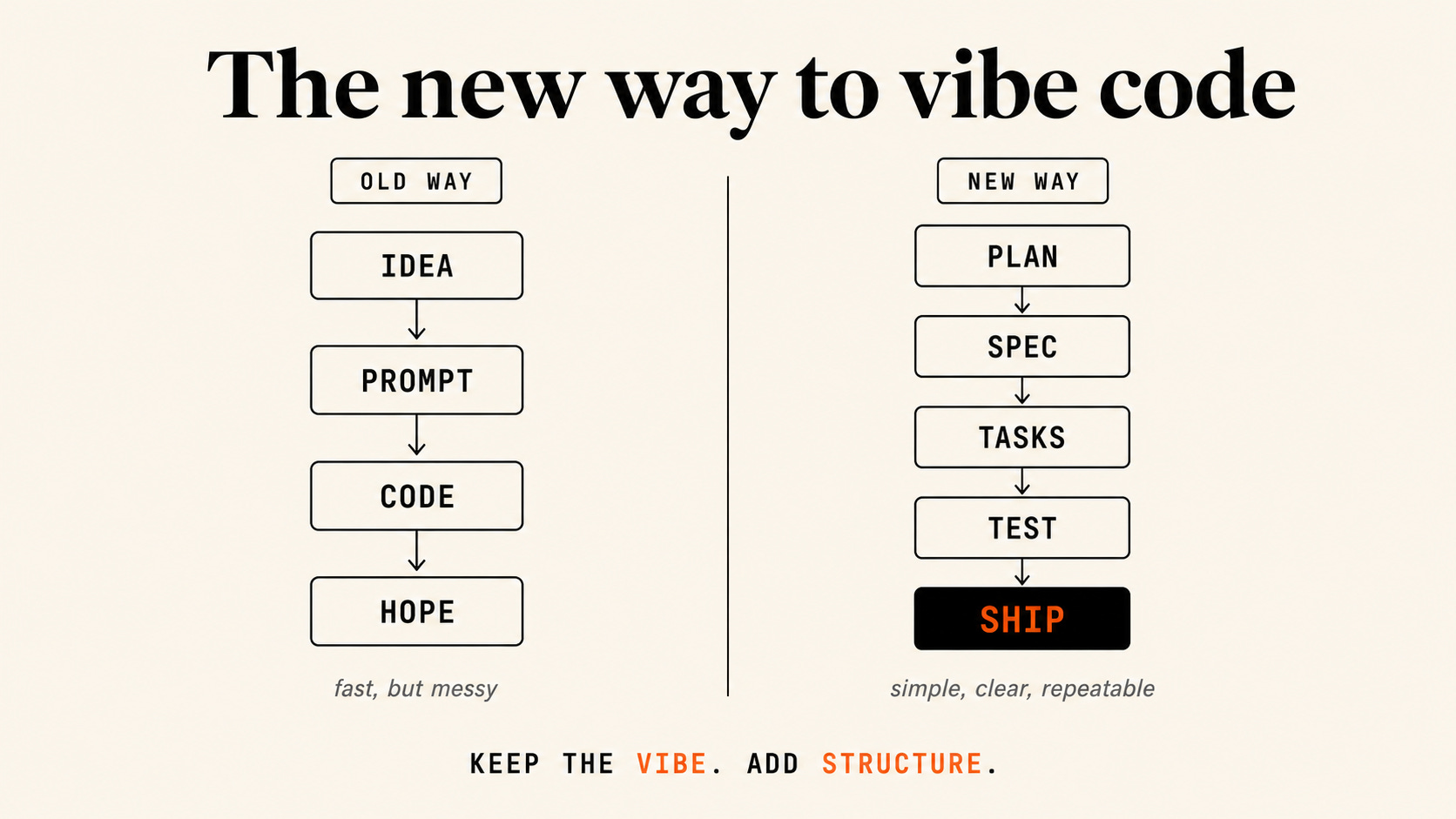
The better workflow now looks like this:
idea → simple plan → small tasks → AI builds → AI tests → you check → continue
Not:
idea → giant prompt → 4,000 lines of code → hope
That small difference changes everything.
Inside the full guide: the new way to vibe code in 2026: when to use quick mode vs real-project mode, how to use SPEC.md, GitHub Spec Kit, project memory, reusable Skills, MCP and APIs, agent loops, graphs, cheaper vs stronger models, token and cost controls, security checks, and a simple setup you can copy for real AI projects.
