What Is Agentic AI? Beginner’s Guide
The simplest way to understand AI agents, agentic systems, RAG, skills and workflows

Everyone treats AI like a smart assistant stuck behind a keyboard.
You ask a question, it answers, and then the real work starts. You open the browser, dig through files, update the spreadsheet, send the email, check if any of it actually worked.
Agentic AI skips that last part.
Instead of asking for an answer, you hand it a goal. It figures out what it needs, picks a tool, does something, checks the result, and keeps going until the job’s done, or until it hits a spot where you need to step in.
That doesn’t mean handing a chatbot the keys to your whole computer. A good agent usually does one job well, with a handful of approved tools, tight limits, and a clear log of everything it touched.
The real difference isn’t smarts. It’s action.
Ask a regular chatbot this:
“Write a follow-up email for customers who haven’t replied.”
It writes you an email. You’re still the one tracking down who hasn’t responded, checking their status, copying the message over, hitting send, and logging what happened.
Now give an agent this instead:
“Find customers who haven’t replied in seven days. Draft a follow-up in our usual tone. Show me the list and wait for my okay before sending anything.”
Suddenly the AI has to pull records, apply a rule, write the drafts, lay out its work, and stop at a checkpoint for your approval.
The model itself is only part of the story. What actually makes something “agentic” is everything around it: the instructions, the tools, the memory, the data it touches, the guardrails, and the record of what happened.
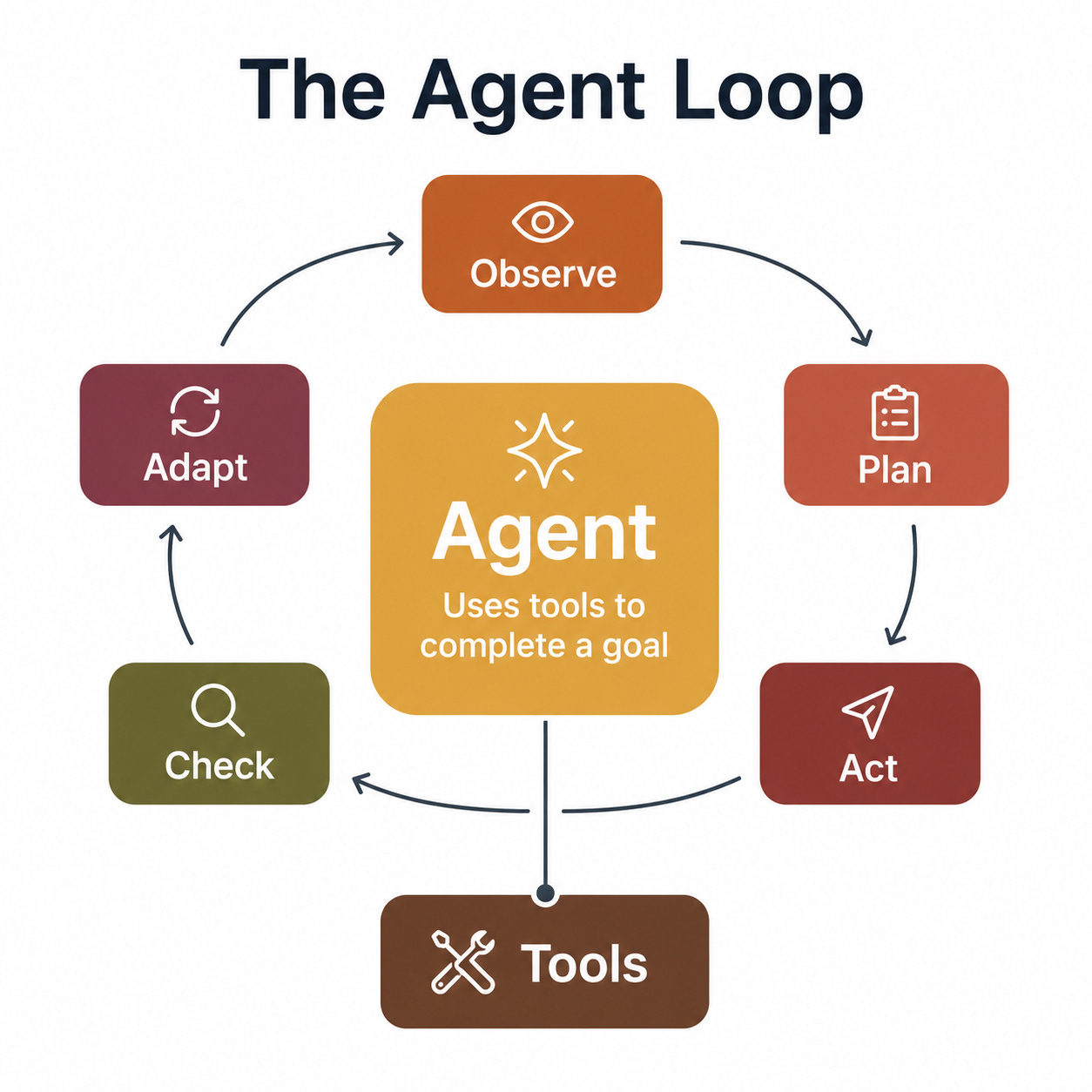
Anthropic draws a useful line here: a workflow runs through steps someone already mapped out, while an agent decides on its own which steps and tools to use as it goes. And their own advice is to start simple, since agents tend to run slower and cost more than a regular model call.
One small loop explains the whole field
Every useful agent runs some version of this loop:
Goal → Observe → Decide → Act → Check → Repeat or stop
Imagine an inventory agent:
Goal: Keep flour stock above ten bags.
Observe: Read the latest inventory file.
Decide: Stock is eight, so a reorder is required.
Act: Create a purchase-request draft.
Check: Confirm the draft contains the correct item and quantity.
Stop: Ask a manager to approve the order.
A plain large language model can reason and write. An agent adds the loop and tools. An agentic system adds the machinery that makes the loop reliable: retrieval, memory, permissions, retries, monitoring and human approval.
Inside the full guide, you’ll clearly understand LLMs, AI agents, workflows, agentic systems, RAG, memory, tools, MCP and multi-agent setups then build a small working agent from scratch with real commands and code. It also covers the five patterns worth learning, how agentic skills work, how to test agents before deployment, where human approval is essential, and which real tasks are actually worth automating.
